

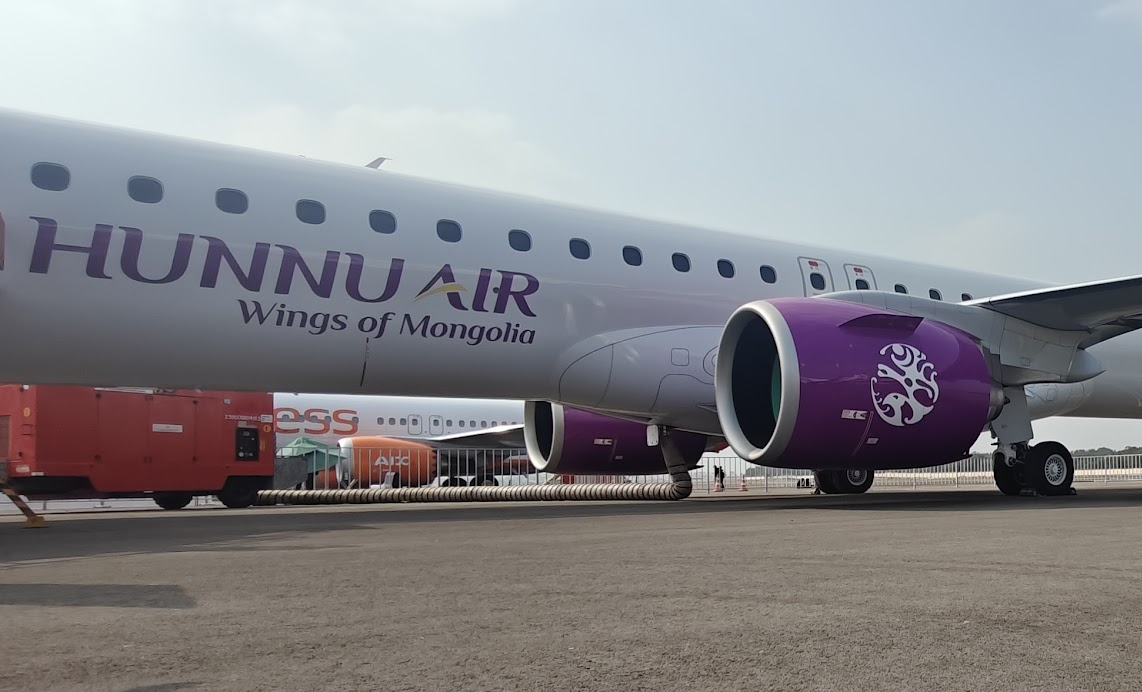
Hunnu Air, Mongolia’s largest scheduled carrier, will begin non-stop flights between Ulaanbaatar and Delhi from 28th September 2026, becoming the first Mongolian carrier to operate a scheduled service to India. The route will be flown once a week, every Monday, with MR301 departing Ulaanbaatar (UBN) at 0350hrs to reach Delhi (DEL) at 0720hrs, and the return MR302 leaving Delhi at 0820hrs to land back in Ulaanbaatar at 1620hrs. The pairing will be operated by the airline’s Embraer 195-E2, the newer of the two E-Jet types Hunnu Air has been inducting since 2025 as part of a broader fleet renewal exercise.
The overnight-out, evening-back structure is fairly standard for a thin, long, single-frequency route where the aircraft needs to be productive on both legs rather than sit on the ground. The early Delhi arrival at 0720hrs lines up with onward connections onto the Indian domestic network and to the Gulf, while the 1620hrs arrival back into Ulaanbaatar is well timed for a same-day rotation back into Hunnu Air’s Mongolian network. The air route makes the flights longer than what a straight line distance would take. However, the Embraer E195-E2 are specifically designed for long thin routes. However, a once a week operation is not the best in terms of scheduling but a cautious bet none the less.
A relationship built not just economics
Diplomatic relations between India and Mongolia were established on 24 December 1955. The Embassy of India was opened in Ulaanbaatar opened on 22 February 1971. India and Mongolia describe their relationship through what officials on both sides call the “3 Ds”: Democracy, Dharma and Development. Of the three, Dharma carries the most weight in the popular imagination. Mongolia refers to India as its “spiritual neighbour,” a status distinct from and layered on top of its formal Third Neighbour Policy, the framework Ulaanbaatar uses to build ties with powers other than its only two physical neighbours, Russia and China. Buddhism travelled to Mongolia via the Himalayas and Tibet centuries ago, and that lineage is still visible today in institutions like Gandan Monastery in Ulaanbaatar, which Narendra Modi visited during his 2015 trip, the first ever by a sitting Indian Prime Minister to the country.
That 2015 visit elevated the relationship to a “strategic partnership,” alongside a billion-dollar line of credit and thirteen agreements, one of which specifically covered air services. It has taken over a decade for that air services understanding to translate into an actual scheduled non-stop flight, a gap that says less about political will and more about the economics of a genuinely thin market. Diplomatic warmth has never been the constraint between India and Mongolia; traffic volume has been.
Why now, and why this is a cautious bet
Mongolia sits in an unusual geopolitical position: landlocked between two much larger powers it has complicated histories with, and structurally dependent on both for trade despite decades of trying to diversify away from them. China takes the overwhelming share of Mongolian exports, chiefly coal and copper, and Russia dominates its energy imports. The Third Neighbour Policy exists precisely because Ulaanbaatar wants options beyond that dependency, and India, a large, friendly, non-adjacent democracy with no territorial history in the region, fits that role neatly on paper. In practice, Indian companies have struggled to compete with Chinese capital on Mongolia’s own turf, which is part of why this connectivity push has leaned on the softer pillars of pilgrimage and cultural tourism rather than a pre-existing trade corridor. Indian companies are currently engaged in building first refinery in Mongolia and to transfer employees of that project Hunnu Air had operated a flight in the middle of COVID to Delhi.
The demand base for a once-weekly flight is therefore a blend of a few distinct pools: Mongolian Buddhist pilgrims travelling to Bodh Gaya and other sites tied to the Buddha’s life, a modest but growing Indian business and diplomatic presence in Ulaanbaatar, and general leisure and VFR traffic that has previously had to route via Seoul, Beijing, Almaty or Hong Kong. One weekly frequency is a toe in the water in the same way most new long, thin, low-frequency international launches are, testing a market before committing a second rotation or a bigger aircraft. This puts questions on the costing of the route since it would require special exemptions for crew flight duty times as well as costs on the ground handling side which arent the most optimum for a once a week departure.

Network Thoughts
The more interesting story here isn’t Ulaanbaatar-Delhi in isolation, it’s what this route does to Delhi’s map. Over the last few years, IGI Airport has quietly filled in almost every gap in India’s connectivity to the wider Central Asian and former Soviet space: Air Astana covers Kazakhstan, Uzbekistan Airways flies to Tashkent, Somon Air links Dushanbe, Turkmenistan Airlines has resumed and grown Ashgabat, and Air Manas covers Bishkek. Mongolia, geographically and culturally distinct from that Turkic-Persian belt but grouped with it in most connectivity conversations about India’s “Eurasian gap,” was the one meaningful capital left unconnected. Hunnu Air’s launch effectively closes that gap, giving Delhi a non-stop link to every landlocked Eurasian capital in its immediate connectivity ambitions.
Once-weekly Monday-only service is about as light a commitment as a scheduled route can carry, and the real test will be whether Hunnu Air can hold this through a full Mongolian winter, historically the toughest season for any route out of Ulaanbaatar given the sharp seasonal dip in outbound leisure demand. If the pilgrim and cultural-tourism traffic proves durable enough to justify a second frequency, expect it to come in the April-to-September window, when Mongolia’s own tourist season and the peak Buddhist pilgrimage calendar in India overlap. For now, though, this is a relationship of six decades finally getting the direct flight its own joint statements promised back in 2015.
Found this article informative? Think of supporting Network Thoughts with Power of 10

Running this website incurs some cost, along with the data sourced for analytics. If you have liked this article, consider paying INR 10 via UPI. The site will continue to be free. This will help with the maintenance, upkeep and funding the research. You can also pay via Debit or Credit card by clicking on this link.
You can support Network Thoughts by ordering Network Thoughts baggage tags and lapel pins !
Follow NetworkThoughts on X (Formerly Twitter), Bsky, Facebook and YouTube