

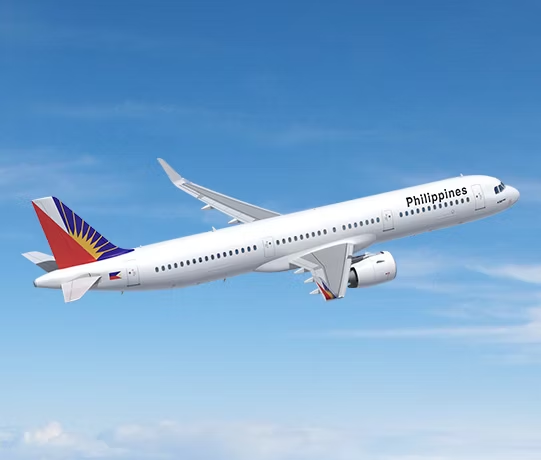
Philippine Airlines (PAL) plans to launch nonstop flights from Manila to Delhi and Mumbai in December 2026, subject to approval from the Government of India. The airline will fly three times a week to Delhi and four times a week to Mumbai, using its 168-seat Airbus A321neo with 12 lie-flat Business Class seats and 156 Economy seats. The flights will offer full service with inflight meals and entertainment. The airline also plans vegetarian and Jain meal options for Indian travellers.
PAL is also marketing the routes beyond Manila. The services will connect with PAL flights from Sydney, Melbourne, Brisbane and Perth, giving Australian travellers another one-stop option to Delhi and Mumbai. If the flights go ahead as planned, Mumbai will get its first-ever nonstop link to the Philippines, and Delhi will get a second carrier on a route Air India has had to itself for just over a year. For PAL, this is the third attempt at India in fifteen years. The first attempt was withdrawn and the second never took off.
Six decades of history
PAL’s history with India goes back further than most people realise. The airline served Kolkata in the 1950s as one of several intermediate stops on its service to Europe, and flew to New Delhi via Bangkok from 2011 to 2013. The Delhi route was dropped because the market was judged too small, and it ran via Bangkok because the A320s of that era could not fly the sector nonstop. On the Indian side, Jet Airways came close to launching Mumbai – Manila in 2012, but dropped the plan before the first flight.
The regulatory groundwork came in 2018. On 12th July 2018, India and the Philippines signed an MoU revising their Air Services Agreement and raising the entitlement from seven to 28 weekly frequencies. Philippine carriers could fly to Delhi, Mumbai, Kolkata and Chennai, while Indian carriers got Manila plus three more points to be nominated later. Bangkok remained an intermediate point with full fifth freedom rights, and India opened 18 points to any point in the Philippines. The first agreement dates back to 1949 and was revised in 2005. The quadrupled entitlement meant capacity was no longer the constraint. What was missing was an airline willing to take the risk. PAL stepped up within months.
2019: The route that never took off
In December 2018, PAL filed a four-times-weekly A321neo service to New Delhi for Summer 2019. The daytime timings had a problem: they connected poorly to North America and Japan, so the route would have depended almost entirely on India – Philippines traffic. By January 2019, PAL moved the flights to a red-eye schedule starting 17th April 2019, with the new timings connecting smoothly to Cebu, Nagoya, Seoul, Osaka and Busan. PAL also priced aggressively against Chinese carriers: Delhi – Manila was around INR 23,000, while Beijing and Shanghai via Manila sold for as little as INR 13,000.
| – | Original filing (Dec 2018) | Amended (Jan 2019) | Proposed (Dec 2026) |
|---|---|---|---|
| Flight numbers | PR726/727 | PR726/727 | PR642/643 |
| Manila departure | 07:15 | 20:45 | 22:40 |
| Delhi arrival | 12:35 | 01:00 (+1) | 03:00 (+1) |
| Delhi departure | 13:35 | 01:45 | 08:15 |
| Manila arrival | 22:35 | 10:45 | 17:00 |
| Ground time at Delhi | 1 hour | 45 minutes | 5 hours 15 minutes |
| Weekly frequency | 4 | 3 (4th from May 2019) | 3 |
| Aircraft | A321neo | A321neo | A321neo (12J / 156Y) |
Source: NetworkThoughts
Then came the surprise. PAL pulled out at the last minute and cited airspace closure as one of the reasons. That closure was on the western front, after Pakistan shut its airspace to Indian traffic following the Balakot strike. The Manila – Delhi track runs over Southeast Asia, Myanmar and Bangladesh and never comes near Pakistani airspace. The closure affected westbound flights out of India, not a route arriving from the east. The more likely explanation is commercial: India – Pakistan tensions spooked bookings just weeks before the planned start. The pandemic followed, and the idea went quiet for five years.
Air India breaks the jinx
It was an Indian carrier that finally broke the jinx. Air India announced Delhi – Manila in June 2025 with five weekly A321neo-family flights, timed to connect with its European bank to London, Frankfurt, Paris and Milan on every day of operation. The route launched on October 1, 2025 with ex-Vistara A321LRs in a 188-seat, three-class layout. Air India went daily from December 11, 2025, just over two months later.
Traffic has grown in both directions every quarter. DGCA point-to-point data shows load factors in the high 70s to mid 80s on the A321LR:
| Quarter | DEL–MNL pax | MNL–DEL pax | DEL–MNL LF | MNL–DEL LF |
|---|---|---|---|---|
| Oct–Dec 2025 | 10,928 | 9,871 | 75% | 83% |
| Jan–Mar 2026 | 13,132 | 13,383 | 79% | 78% |
| Apr–Jun 2026 | 14,508 | 13,338 | 77% | 84% |
That is just over 75,000 passengers in the first nine months, and it does not include passengers connecting over Delhi. The next step is a bigger aircraft. This winter, Air India replaces the A321LR with the legacy 787-8, which seats 259 in two classes: roughly 38% more seats per departure, but without Premium Economy. With Philippine Airlines lining up to India, the additional capacity of Air India would be a very good revenue tool to make the flights competitive.
The tailwinds: visas, trade and defence
The market PAL is entering is very different from the one it left. Tourism has turned. Indian arrivals in the Philippines grew about 17% in January to November 2025, reaching 85,885, and the first four months of 2026 saw 49,592 Indian tourists, up about 68% year on year. That is still a small share of the roughly 5.9 million foreign visitors the Philippines recorded in 2025, which is exactly why Manila is courting India. Visa policy has helped in both directions. Since 8th June 2025, Indians can enter the Philippines visa-free for 14 days for tourism or business. Holders of US, Japanese, Australian, Canadian, Schengen, Singapore or UK visas or residence permits get 30 days. In return, India offered Filipinos a free 30-day e-Tourist visa for an initial year, from August 1, 2025 to July 31, 2026. The standard e-Visa remains available either way.
Trade has nearly doubled in a decade. Bilateral trade grew from about US$1.98 billion in 2016-17 to US$3.05 billion in 2022-23, and reached US$3.9 billion in 2025-26, according to the Joint Working Group on Trade and Investment meeting in Manila in June 2026. India runs a surplus, exporting pharmaceuticals and aircraft parts and importing pearls and electrical machinery. Defence ties have become the backbone of the relationship. India’s US$375 million BrahMos deal with the Philippines in 2022 was its first major defence export in Southeast Asia, and the missiles were delivered in two batches, in April 2024 and April 2025. On August 5, 2025, the two countries elevated ties to a Strategic Partnership with a Plan of Action for 2025–2029, and signed 13 agreements during President Marcos Jr.’s visit. Business and government travel follows ties like these, and much of it will want a flag-carrier Business Class seat.
Reading PAL’s schedule
Until October 2025, all traffic between the two countries went via a hub: Singapore, Bangkok, Kuala Lumpur, Hong Kong, Ho Chi Minh City or Hanoi, and Guangzhou. Mumbai still depends on these one-stop routings today, as do Chennai, Bengaluru, Hyderabad and Kochi. Air India’s numbers only capture Delhi. PAL’s Mumbai flight is the one tapping a genuinely unserved nonstop market, and it gets four weekly flights to Delhi’s three. The schedule points to a single-aircraft operation. One A321neo can leave Manila at 22:40 every night, alternating between Delhi and Mumbai, and return the next evening at 17:00. That gives seven weekly flights from one airframe, with about 5h40 on the ground in Manila. Unlike the 45-minute red-eye turn planned in 2019, the aircraft now sits in India for 4 to 5 hours and flies back in daylight. The 17:00 arrival in Manila appears built to feed PAL’s evening departures, with Australia connections already being marketed and North America and Japan likely targets. The 22:40 departure from Manila collects traffic from the rest of the network. Capacity will jump. Air India’s daily A321LR offers about 1,316 seats each way per week. With the 787-8 and PAL’s seven weekly flights, weekly one-way nonstop seats rise to roughly 2,989, more than double. Delhi alone goes up about 76%.
Network Thoughts
PAL’s third attempt is better placed than its first two. In 2011 the market was too thin for a one-stop service via Bangkok. In 2019 PAL had a good aircraft and the 2018 bilateral, but no proof of demand, and it lost its nerve at the first sign of trouble. In 2026, the proof exists. Air India has shown the route can fill a 188-seat aircraft daily and justify a widebody within a year, while visa-free entry, trade approaching US$4 billion support demand in both directions.
Frequency will decide the Delhi contest. Three weekly flights against a daily Air India Dreamliner is a tough sell for corporate travellers, and PAL will need to go daily sooner rather than later. Mumbai is where PAL can build a stronghold before IndiGo arrives. The bilateral may also become tight quickly. Each side has 28 weekly frequencies. If Air India stays daily and IndiGo launches daily Delhi and Mumbai services, the Indian side will use 21 of its 28, and any move to Cebu or a southern Indian city would push the countries back to the negotiating table within a couple of years.
The phrase “subject to Indian Government approval” deserves attention, given what happened in 2019. December is only ten weeks away, and morning departure slots at Delhi and Mumbai are hard to come by. If PAL gets the approvals, the India – Philippines market could go from zero nonstop flights in September 2025 to three airlines within about eighteen months. For a pair of countries that signed their first air services agreement in 1949, that would be worth the wait.
Found this article informative? Think of supporting Network Thoughts with Power of 10

Running this website incurs some cost, along with the data sourced for analytics. If you have liked this article, consider paying INR 10 via UPI. The site will continue to be free. This will help with the maintenance, upkeep and funding the research. You can also pay via Debit or Credit card by clicking on this link.
You can support Network Thoughts by ordering Network Thoughts baggage tags and lapel pins !
Follow NetworkThoughts on X (Formerly Twitter), Bsky, Facebook and YouTube