

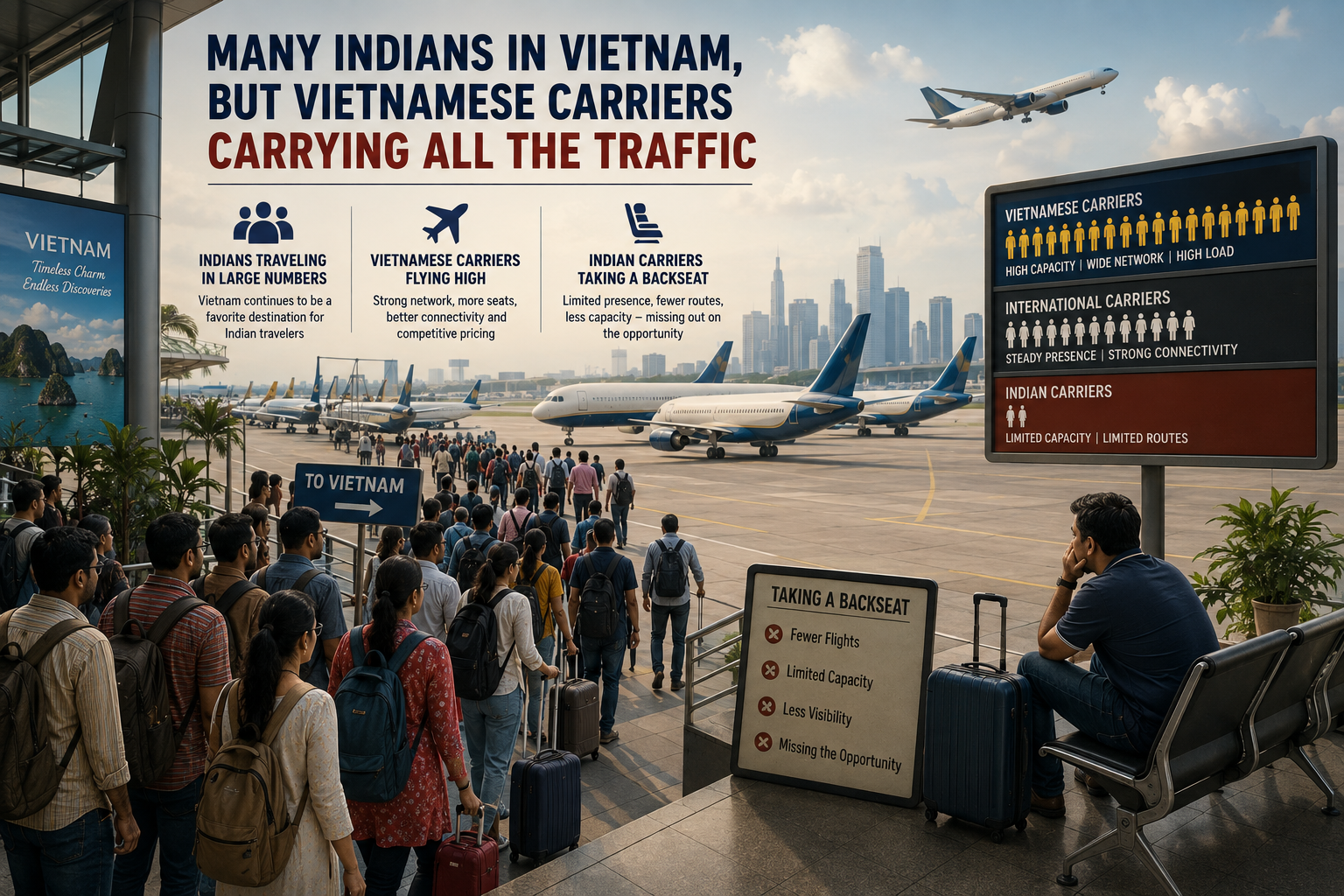
Tourism between India and Vietnam has seen positive growth in recent years. According to data, India is the 8th largest tourist market to Vietnam, with about 507,000 arrivals in 2024, up from 392,000 in 2023. In 2025, the estimated number of Indian tourists to Vietnam has climbed further to around 7 lakh. On the other hand, an estimated 55,000 Vietnamese tourists visited India last year, a fraction of the outbound number. The imbalance is stark: for every Vietnamese national flying to India, there are close to thirteen Indians headed the other way. Yet, when it comes to who is flying these passengers, the picture flips substantially in favour of Vietnamese carriers.
Data sourced from Cirium, an aviation analytics company, exclusively for this article shows that for December, weekly departures each way between India and Vietnam stand at IndiGo 14, Air India 12, Akasa Air 4, VietJet 35 and Vietnam Airlines 21. That’s 86 weekly departures each way, with Indian carriers accounting for just 30 of them against 56 for the two Vietnamese carriers. Despite Indians forming the overwhelming majority of the traffic, Indian carriers control barely a third of the frequencies, a pattern that has held since scheduled services began.
A market that started from near zero
Before late 2019, there was no non-stop connectivity between India and Vietnam, with passengers largely routing via Bangkok, Singapore or Kuala Lumpur. That changed when IndiGo announced its first flights to Vietnam in July 2019, launching Kolkata-Hanoi from October 3, 2019, operated seven times a week by A320 family aircraft. The choice of Kolkata over Delhi or Mumbai was notable at the time, given that the largest India-Vietnam markets were understood to be Delhi-Ho Chi Minh City and Mumbai-Ho Chi Minh City, but it allowed IndiGo to de-risk the launch while still connecting onward via its strong Kolkata network. VietJet followed within weeks, launching its first direct services from Delhi to Ho Chi Minh City and Hanoi in December 2019, becoming the second airline with scheduled non-stop flights on the route.
Even in that early phase, tourism was growing at roughly 20%, driven mainly by Indian travellers, with news reports at the time projecting over 200,000 Indian visitors to Vietnam for 2019. That number has since more than tripled, but the imbalance between demand and capacity has, if anything, widened.
Why the capacity mismatch persists
The skew reflects the fundamentally different playbooks of the airlines involved. VietJet, as a Vietnamese low-cost carrier, treats the India corridor as a core outbound growth market and has been willing to open tier-II Indian cities like Ahmedabad and Kochi well ahead of Indian carriers, deploying both narrowbody and Airbus A330 widebody aircraft on the longer sectors. With 35 weekly departures, it alone accounts for more frequencies than all three Indian carriers combined. Vietnam Airlines, with 21 weekly departures, has pursued a complementary premium strategy, targeting India’s technology hubs of Bengaluru and Hyderabad specifically to tap business and diaspora traffic rather than only leisure flows.
Indian carriers, by contrast, have been comparatively cautious and fragmented. IndiGo’s 14 weekly departures and Air India’s 12 reflect steady but unhurried growth, largely narrowbody and metro-focused, consistent with each carrier’s broader strategy of incremental international expansion rather than aggressive capacity commitment to any single market. Data from booking engines show that IndiGo is pulling out of Ho Chi Minh city, where it suspended operations starting July in what was a temporary arrangement. Akasa Air’s 4 weekly departures, starting only in September 2026, mark it as the newest and smallest entrant, a first step rather than a network statement. Air India’s own late entry is emblematic of a broader trend in Indian long-haul strategy: the carrier prioritises routes that feed its Delhi hub for onward international connections, and Hanoi only became interesting once it fit that connecting-traffic logic.
The result is a market where demand is driven overwhelmingly by Indian outbound leisure travellers, chasing Vietnam’s scenic destinations, favourable visa policies and cost advantages over more saturated markets like Thailand, but nearly two out of every three weekly departures are Vietnamese-flagged. This isn’t unique to Vietnam; a similar pattern plays out in Malaysia, where AirAsia and other Malaysian carriers dominate capacity despite Indian-origin demand. What sets Vietnam apart is the number of Indian carriers now present, three against Vietnam’s two, even as the frequency split remains firmly in the Vietnamese carriers’ favour.
Network Thoughts
The India-Vietnam market is a textbook case of demand and capacity moving on different timelines. Foreign carriers have historically been quicker to spot underserved bilateral markets and move decisively, while Indian carriers wait for a market to mature before committing meaningful capacity, often citing widebody constraints or network prioritisation elsewhere. That pattern held true for years on the Gulf and Southeast Asian corridors, and it is repeating itself in Vietnam, just with more Indian participants than before.
What makes this market worth watching over the next two to three years is that three Indian carriers are now present, something that wasn’t true even a year ago. IndiGo’s committed A350 deliveries starting 2027 and Air India’s ongoing widebody induction give both carriers the tools to deploy larger aircraft on Southeast Asian trunk routes, especially in markets where the bilaterals are defined by frequency and not capacity, while Akasa Air’s entry signals that even India’s newest carrier sees Vietnam as commercially ready rather than speculative. Air India framing Delhi-Hanoi explicitly as a Europe-Southeast Asia connecting play, rather than a standalone point-to-point route, also signals that Indian carriers are beginning to think of Vietnam less as an isolated leisure market and more as part of a larger network puzzle. Air India with its presence in both the major cities in Vietnam, offers options for European connections to Vietnam with an ability to enter in one city and exit from another.
Foreign carriers demonstrated willingness to open tier-II markets ahead of demand rather than after it. Unless Indian carriers convert their newfound presence into real frequency growth, the passenger numbers may keep tilting toward India, but the metal carrying them will likely keep flying the Vietnamese flag for a while longer.
Found this article informative? Think of supporting Network Thoughts with Power of 10

Running this website incurs some cost, along with the data sourced for analytics. If you have liked this article, consider paying INR 10 via UPI. The site will continue to be free. This will help with the maintenance, upkeep and funding the research. You can also pay via Debit or Credit card by clicking on this link.
You can support Network Thoughts by ordering Network Thoughts baggage tags and lapel pins !
Follow NetworkThoughts on X (Formerly Twitter), Bsky, Facebook and YouTube
[…] and Air India are the other Indian carriers between India and Vietnam, with the market heavily tilted in favor of Vietnamese carriers. IndiGo was the first player in the non-stop market, though it has remained small and made multiple […]