

Indigo – India’s largest carrier by fleet and market share, has been in the news for various reasons recently. From worms in the food served inflight to launch of flights to Ayodhya with much fanfare, the airline is constantly under the spotlight. As we head into the second half of January, the airline will be dealing with increased grounding of its Airbus fleet which is powered by Pratt & Whitney GTF engines. Over and above the several groundings last year, a fresh wave of groundings started this January which has resulted in IndiGo uncharacteristically being forced to scale back operations.
While the airline continues to add new aircraft (powered by CFM) and has also taken over 10 aircraft on damp lease from Smartlynx, the fresh grounding of over 30 planes has forced it to cut capacity. This post analyses the changes that the airline is doing at the six metro airports viz. Delhi, Mumbai, Bengaluru, Hyderabad, Chennai and Kolkata and aims to analyze the cut in capacity to get a sense of how IndiGo sees its network evolve, scale back and return to previous strengths – whenever possible. The analysis is based on domestic network available for sale between November 23 (specifically 24th November as a sample date) prior to these cuts versus February 24 (specifically 2nd February) to understand where the cuts have happened

The data throws up interesting trends
- No cutbacks at Delhi or Mumbai. Both these airports apart from being the leading airports by way of passenger volume are also slot constrained. Indigo has added flights at both airports to Ayodhya (AYJ).
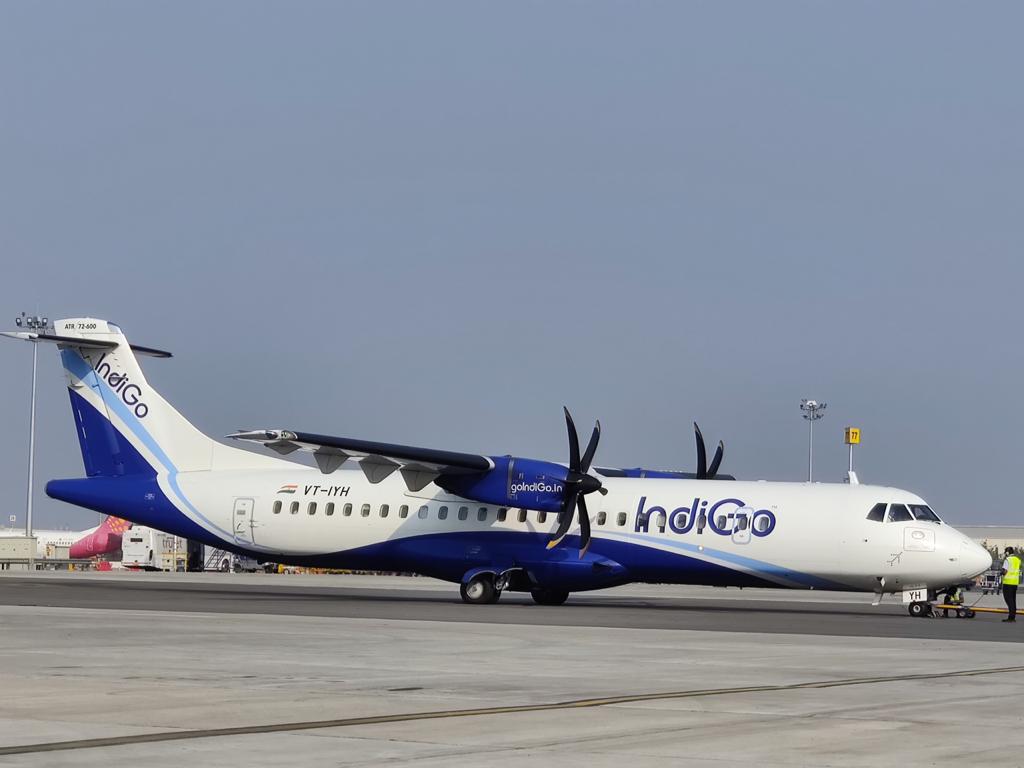
- The ATR fleet has been partially repositioned back from the rest of India to South with a 25% jump in ATR departures at both Bangalore and Chennai, partly compensating for the steep cuts in A320 family flying.
- The sharpest cut back is in Bengaluru in terms of both flights and capacity with a whopping 15% reduction in A320 family flying. While that’s been partially compensated with increased ATR flights, since these are lower capacity (72 seats vs 180-232 seats in the A320 family), the capacity impact will be quite large. At a macro level, this might indicate overcapacity/ poor yields at Bangalore, particularly in intra-south routes where a bulk of this capacity has been cut but Bengaluru also has lesser slot constraints giving the airline the ability to get back the capacity when possible.
- The least cutback has happened at Hyderabad which also has no slot constraint but has seen the least cuts with only a 2.5% cut in departures, possibly because IndiGo does not want to lose any ground to Air India Express which is expanding rapidly ex-Hyderabad.
- Indigo has actually cut a station for the first time – in this case Khajuraho (HJR) that was connected to Delhi via Varanasi and service started recently.
Three principles which seem to guide IndiGo’s planning
- No cuts at slot constrained airports – as seen above, there has been a small but net increase in frequencies to Delhi and Mumbai. Other slot constrained airports like Pune (PNQ) and Goa Dabolim (GOI) have also seen their services protected. In contrast, airports like MIA, Mopa, Goa (GOX), Kochi and Bengaluru have seen sharp cuts. UDAN routes have also been fully protected.
- Several Non UDAN monopoly routes (e.g. Kolkata to Amritsar, Bangalore to Kanpur) have been chopped altogether and others (like Bangalore to Dehradun or Hyderabad to Ahmedabad) have seen frequencies slashed (in some cases from daily to 3 weekly).
- Intra south networks which were high frequency routes have been cut (e.g. Bengaluru – Kochi: from 7 to 5 daily, Bengaluru – Hyderabad: from 10 to 8 daily, Bengaluru – Chennai from 8 to 6 daily). Indigo faces competition in all these routes, particularly from Air India Express and is curiously forsaking frequency leadership in several sectors. Some intra south routes have been moved from high capacity A320 family aircraft to lower capacity ATR routes (e.g. Bengaluru – Coimbatore, Bengaluru – Mangalore) with a sharp reduction in capacity as a consequence
International has remained relatively stable
IndiGo has been far more selective and restricted in cutting international routes. Barring few sectors, it is not possible to substitute A320 family with ATR on International routes and none have seen this substitute. Apart from slots, another factor plays its part in international – bilateral rights!
The airline has cut Kochi to Bahrain, Chennai to Muscat and Hyderabad to Dhaka. Cuts have happened to destinations where rights are freely available (e.g. Dammam which is a free port) and can be added back in short time. Indeed, Indigo has actually expanded services to Phuket from both Mumbai and Bangalore in this period. However it remains to be seen whether Indigo can maintain the pace of international expansion given these groundings. A very interesting cut back was on the Delhi to Male sector which was introduced only on October 23 where Indigo competes with Vistara. Given guidance on expansion to Bali (DPS) and Medina (MED) that was shared in the last analyst call, Indigo will likely keep expanding its network – just that it will probably come at a slower pace than prior. Another interesting dynamic to watch will be how Indigo plans ahead for increased capacity at Delhi (DEL) where all 4 runways will finally be in use from later in January and Terminal 1 opens in the near future. Summer 2024 will be interesting for sure.
The dry leases of A320ceo which were unannounced are yet to enter the fleet. IndiGo is likely to lose market share starting February and it needs to be seen who gains from this? The expanding Air India Express or cash infused SpiceJet?
About the author : This guest contributor is an aviation enthusiast whose day job is in consumer goods. A frequent flyer (1300 + flights logged) and a data geek with a love for analysing airline networks and their evolution. On X (formerly Twitter)and other platforms as @BOMLHR
You can now order Network Thoughts baggage tags and/or book marks!
Follow NetworkThoughts on Twitter, Facebook, Telegram and YouTube.