

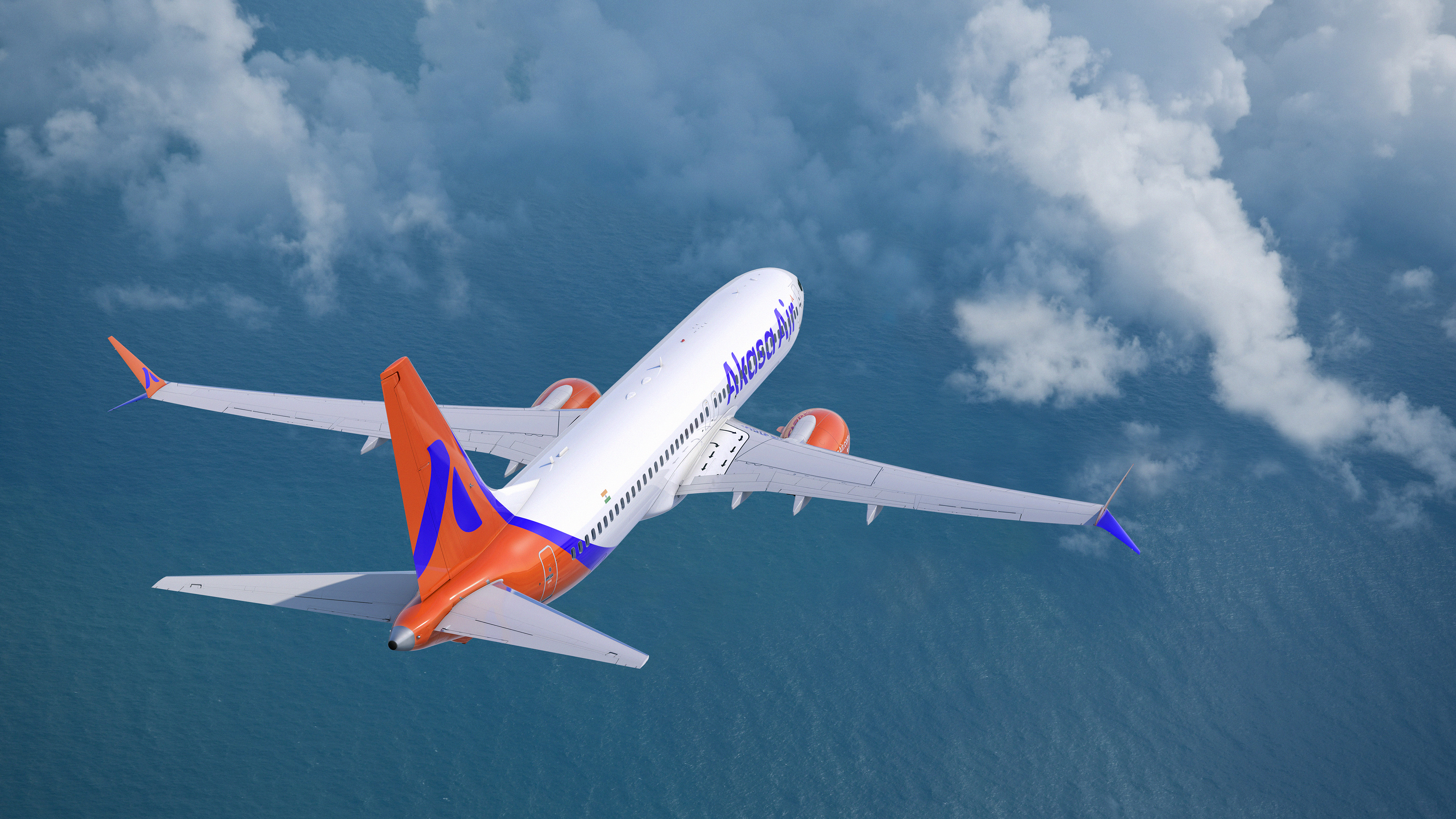
Akasa Air has completed four years of commercial operations today. The airline flew its first flight on August 7, 2022, from Mumbai to Ahmedabad with a network of just 36 weekly flights. Four years on, Akasa operates over 1,000 weekly flights on a fleet of 40 Boeing 737 MAX aircraft, connecting more than 30 destinations across its domestic and international network. The anniversary also arrives on the back of the airline’s best-ever run in the domestic market, with its highest ever market share and passenger numbers recorded in May and June this year.
According to DGCA data, Akasa’s domestic market share climbed from 5.8% in May to 6.4% in June 2026, its best ever, as the airline carried 8.61 lakh domestic passengers in June and posted the highest passenger load factor in the industry at 92.2%. This came at a time when Air India Group was cutting capacity amid the West Asia conflict’s impact on Gulf-bound flying, and IndiGo touched its own record of 66.3% share the same month. Akasa’s steady climb through this period, even as the overall market moderated, is a reasonable marker to pause on as the airline turns four.
From 36 flights to a top-three carrier
Akasa Air was born out of a September 2021 announcement by a group of former Jet Airways and Go First executives, backed by the late Rakesh Jhunjhunwala’s $35 million investment for a 40% stake. It began flying in August 2022 with a single Boeing 737 MAX 8 aircraft and grew into India’s third-largest domestic airline within four years, a pace few Indian carriers, barring IndiGo itself, have matched.
The airline crossed the one-year mark with 11 million cumulative passengers and had, by mid-2024, expanded to 24 Indian cities. Its first international flight came in March 2024, connecting Mumbai to Doha, making it the fastest Indian carrier to go international within 19 months of starting operations. The network since then has added Jeddah, Riyadh, Dubai, Kuwait and other Gulf points, alongside a steadily filling domestic map that leans on Bengaluru and Mumbai as its two operating bases. The airline will launch flights to Vietnam later this year.
The fleet, however, has grown more unevenly than the airline would have liked, and the aircraft-by-aircraft induction record makes that visible in a way headline fleet numbers don’t. Akasa took delivery of 14 aircraft in its first seven months of existence, from June to December 2022, a pace close to two aircraft a month that let it scale quickly out of the gate. That pace nearly halved in 2023, to eight aircraft, with deliveries thinning out to one every few months by the second half of the year. Then came 2024, the airline’s worst year for inductions by far, just four aircraft delivered across the full twelve months, including a seven-month stretch between February and September with no deliveries at all, a direct consequence of the Alaska Airlines door-plug fallout and Boeing’s machinist strike disrupting the 737 MAX line industry-wide. Some of the early aircraft were also meant for other carriers and thus featured dual class configuration.

Deliveries picked up modestly in 2025, five aircraft across the year, before accelerating sharply again in 2026: nine aircraft in the first six months alone, already matching the entire 2023 tally and closing in on the 2022 pace. The 40th aircraft, delivered on July 3, 2026 via Seattle-Reykjavik-Cairo-Bengaluru, was part of that reacceleration. At the low point in early 2025, the airline had hundreds of trained pilots grounded with no aircraft to fly them, a genuinely difficult phase for a carrier whose entire growth model depends on Boeing’s delivery cadence. The 2026 numbers suggest that phase is finally behind it.
Elevate – New loyalty program
On its fourth anniversary, Akasa Air has launched a loyalty program. Akasa Elevate enables members to earn Elevate Points on eligible flights and ancillary products & services, unlock exclusive benefits through fast and easy tier progression, and enjoy India’s most rewarding way to fly, says the airline press release.
Key features of Akasa Elevate
1. Fast and easy tier progression | Members can qualify through either eligible flights or eligible spends, making progression through the four tiers more intuitive and aligned with the way they naturally travel.
2. Earn Elevate Points on flights and ancillary products & services | Members earn Elevate Points on eligible spends on flights and ancillary products & services, with additional rewards on eligible direct bookings and rewards on ancillary purchases ensure passengers benefit every time they choose Akasa.
3. Unlimited priority services and exclusive benefits | Practical travel benefits, allowing members to enjoy unlimited priority services and exclusive benefits as they progress through the membership tiers.
4. Value beyond points | Benefits extend across seats, baggage, meals, priority services and travel flexibility, delivering value throughout the journey, not just through future redemptions.
5. Dedicated member care and personalised recognition | Premium members enjoy personalised recognition, dedicated member support and enhanced airport experiences.
Akasa Air is also offering a limited period Retro Claim for their travel with the airline even before the launch of Akasa Elevate. Passengers who have flown with Akasa Air since 1 April 2026 can join Akasa Elevate and claim their Elevate Points retrospectively.

Staying away from the wet-lease route
What stands out through this delivery crunch is what Akasa chose not to do. Both IndiGo and SpiceJet have leaned on wet and damp leased aircraft to plug capacity gaps, whether from engine issues, or their own slippages, bringing in leased Airbus and Boeing aircraft, along with foreign crew in some cases, to keep schedules intact. Akasa avoided that route entirely, choosing instead to absorb the pain of a slower fleet build rather than plug it with wet-leased capacity, even as its own aircraft-to-pilot mismatch grew uncomfortable through 2024 and early 2025.
This is a meaningfully different growth philosophy for an Indian LCC. Wet leasing solves a short-term capacity problem but complicates cost structure, crew standardisation and, at times, on-time performance and reliability metrics, all areas where Akasa has otherwise tried to build its reputation. The airline’s June 2026 numbers, the highest load factor in the industry alongside a rising market share, suggest that the more conservative, all-owned-metal approach has not cost it the operational consistency it was chasing, even if it meant growing the network slower than originally planned.
Network Thoughts
Four years in, Akasa’s story is really a story of patience through someone else’s supply problem. The airline bet its entire growth model on Boeing’s delivery cadence, and when that cadence broke down industry-wide, it chose to eat the cost internally rather than pass the strain onto its network through wet-leased aircraft, the way its two older domestic rivals have both done at various points. That is a harder path in the short term, but it is the one likelier to protect the brand consistency Akasa has built its identity around.
The bigger question now is what the next phase of growth looks like once Boeing’s delivery rate genuinely normalises, something the airline’s own CXO’s has suggested is still not immediate. Does Akasa use that eventual acceleration to deepen its Gulf network, where Air India Group’s capacity troubles have opened real gaps, or does it turn inward toward UDAN and secondary Indian markets, an option it has publicly said it is evaluating? And with SpiceJet continuing to fade and Air India Group ceding domestic share through 2026, where will Akasa Air be? A strong challenger to Air India or looking for gaps in other’s network to fill the void?
Found this article informative? Think of supporting Network Thoughts with Power of 10

Running this website incurs some cost, along with the data sourced for analytics. If you have liked this article, consider paying INR 10 via UPI. The site will continue to be free. This will help with the maintenance, upkeep and funding the research. You can also pay via Debit or Credit card by clicking on this link.
You can support Network Thoughts by ordering Network Thoughts baggage tags and lapel pins !
Follow NetworkThoughts on X (Formerly Twitter), Bsky, Facebook and YouTube