

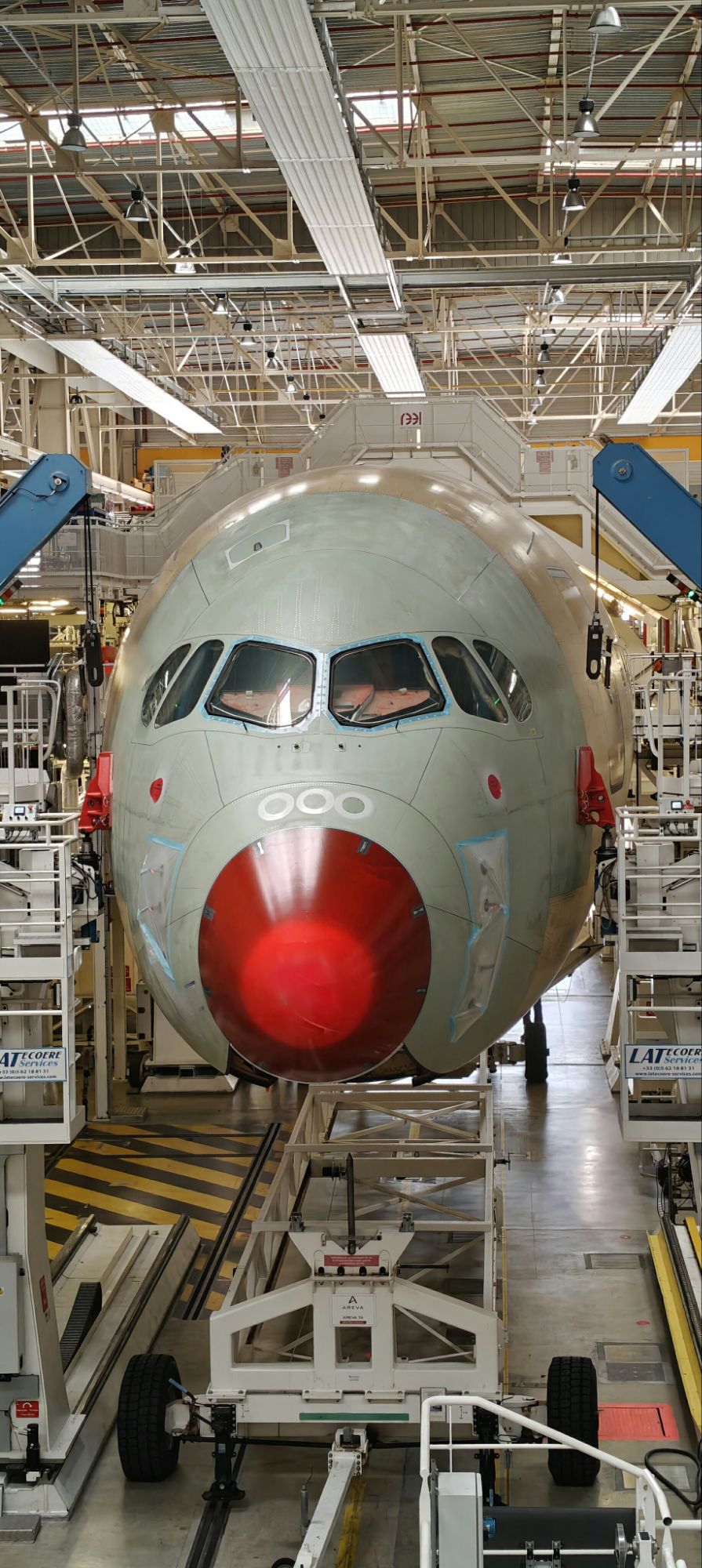
I worked for three different airlines in the past, all of which were Airbus operators. Since childhood I have always wanted to see “How planes are made” and the opportunity finally presented itself in Toulouse this year, when Airbus invited me to attend the Airbus Summit 2025, followed by a visit to the Final Assembly Line (FAL) of the A350 and the A321.
The two days of Summit saw discussion on varied topics with Sustainable Aviation Fuel, meeting the Airbus CEO and visiting the exhibition were the highlights, along with the star which was discussion about a clean sheet design for next decade. The day after was a visit to the FAL which was restricted to a handful and not part of the Summit. As the bus picked us up from the hotel, the Airbus team had a plan in place for the whole day and security clearance with passport scan and temporary ID cards were the first. The Airbus plant is spread (literally) across the two sides of Toulouse Airport. The first stop of the day was at the A350 FAL, which is towards the South-West of the airport. The first A350 flew in 2013, while the commercial service started in 2015.
First stop was the small conference room in a massive hanger where instructions on emergencies, Do and Don’ts were handed out followed by a brief on the A350, the hanger and some key numbers. The entire area is out of bounds except for conducted tours, invitees and Airbus employees having access to the A350 hangar. There are blue markings on the ground for the path to follow, and the aviation angle apart – it is an industrial site.


The first stop was on the second floor explaining the assembly and various stations along with the journey of various parts. The A350 is exclusively manufactured at Toulouse and the three versions, -900,-1000 and the freighter share the same line. The freighter is not in commercial service yet. For the A350, the wings are manufactured at Bremen or Broughton, the Aft fuselage & vertical tail plane at Hamburg, Forward & Centre fuselage at Saint-Nazaire, Horizontal Tail Plane at Getafe while Pylon & Nacelle is manufactured at Saint-Elol. These sections come to Toulouse by various modes including the Beluga XL.

The different stations have their jobs assigned and in Airbus, the station number decreases as the plane gets ready. The higher the number, the farther away the plane from being ready. The A350 assembly process is well defined and such that cabin installation is made in parallel to structural assembly of the aircraft. Cabin furnishing starts as soon as the section arrives in the FAL and this reduces the overall lead time to produce an A350. Station 59 is assigned for Section preparation where up to 10 sections are received and work starts on them. Section 50 is where the fuselage junction or assembly is done. Station 40 is the all important station where the tail is assigned and so are the wings. At station 40, one can distinctly see the parts which are made from composite material and those (mainly the cockpit section) from aluminium. This is also the station where the aircraft spends the maximum time. First electrical power-on, joining of wings using around 2500 rivers per wing, installation of main landing gear and wheels, pylon installation under the wing, installation of horizontal tail plane, cabin installation and side wall panels, partial seat installation, lighting test, cabin communication test and functional tests are carried here before the plane moves ahead.
This is followed by Station 30 and 18, where Aircraft systems are tested and cabin pressurisation is checked. The last is Station 21, where final cabin installation is done along with engine installation. The aircraft then moves out of the hangar to the apron area which the A350 shares with the A330neo. Engine start up, fuel leakage detection and ground runs are carried at these bays before things can move towards first flight. Station 18 is an outdoor station while station 30 is indoor. The entire line is digital with no paperwork involved and digital tablets used for every instruction and work order. The testing for leaks happens by using Helium. When the aircraft is ready for its first flight, the Airbus test team takes over by powering up the APU, then the engines, emergency braking test and 10 hours of flight test before a customer acceptance flight can be planned. This leads to Transfer of Title (ToT) and eventual delivery flight, which in case of the A350 is non-stop in almost all cases. The current rate of production for the A350 stands at six per month with efforts ongoing to increase it to 10 per month by next year and 12 per month by 2028.
A quick lunch stop later, the gathering moved towards the North East of the airfield closer to the Aeroscopia museum which hosts the latest FAL for Airbus. The hangers are gigantic to say the least and this is where the A380 was manufactured. Airbus opened this FAL in 2023, to increase the production rate of its most successful A320 family. This is a “No photo” building and is modern to the core. The wings, which come by the Beluga, are fully assembled when they reach here and were resting on two automated robots without a single person in sight. As we took a few steps ahead, person-less forklift trucks were carrying pallets and boxes which were then kept within the marked lines, assumingly its pre-determined places. The aim of this production line is to produce 20 planes a month over the next couple of years with current targets being 10 a month which are being met in most months of the year. The initial station here takes care of fixing the sections, radome, weather radar, galleys and flooring. Automated vehicles slide the A321 to the next station. We visited the all important Station 40 where the ceiling, landing gear, engine pylon, wing and many other parts come together to form the final structure of the aircraft. There are demarcated areas where the pallets are placed by automated forklift trucks. This triggers a buzzer which is a message for the workers on the plane to initiate the next job. The drilling of rivets is automated for most parts of the plane and I was in awe of seeing it in action. The rest of the process remains the same for the A321neo as for any other plane.
It was time to bid good bye to the Final Assembly Lines and head to the mock-up centre (to be covered later). The FAL visit has been a dream come true for me and an engineering marvel to see.
Note: I was in Toulouse on invitation from Airbus and sponsored by Airbus for the Airbus Summit. Select few were invited to see the FAL. Photography is controlled at the plant since the customers may not like the in-production photos being circulated.
Found this article informative? Think of supporting Network Thoughts with Power of 10

Running this website incurs some cost, along with the data sourced for analytics. If you have liked this article, consider paying INR 10 via UPI. The site will continue to be free. This will help with the maintenance, upkeep and funding the research. You can also pay via Debit or Credit card by clicking on this link.


You can support Network Thoughts by ordering Network Thoughts baggage tags !
Follow NetworkThoughts on X (Formerly Twitter), Bsky, Facebook, Telegram and YouTube.