

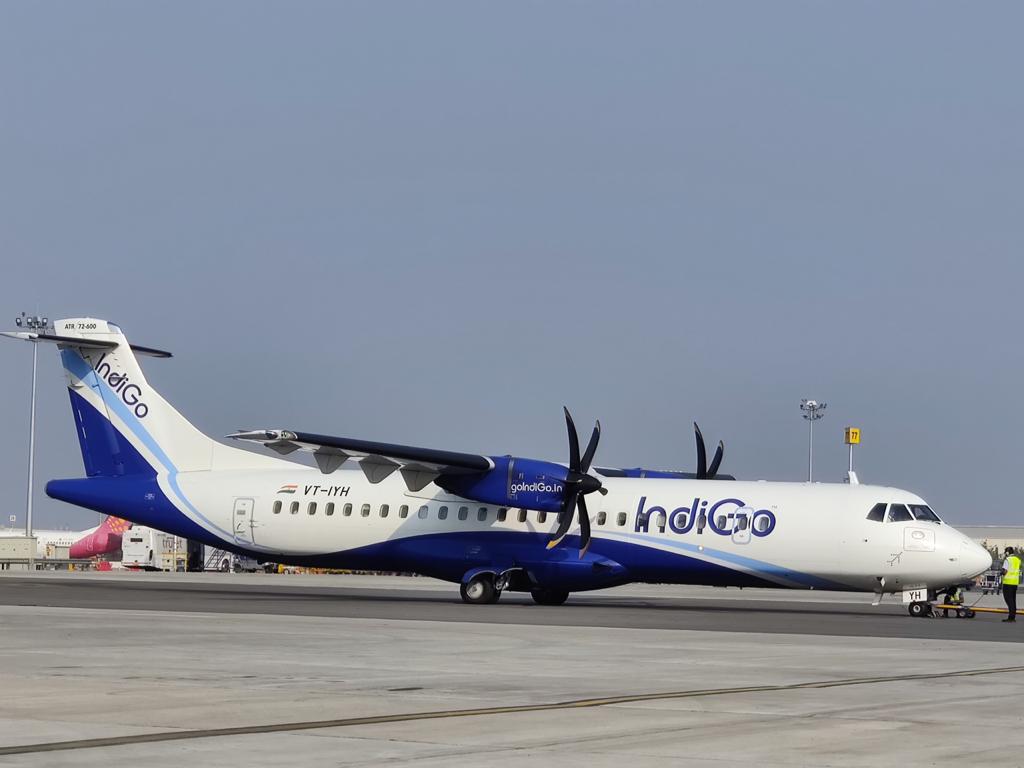
IndiGo, India’s largest carrier by fleet and market capitalization, is shrinking its turboprop network rapidly this month and beyond. Early this month, Twitter user AviationAll_ posted a thread on the reduced ATR operations of IndiGo, which can be found at this link. I decided to investigate further on what changes the airline is doing and if possible convert the schedule to rotations to understand how many aircraft the airline plans to fly in February. Turns out the airline is reducing over 500 weekly flights on the ATR, as per data shared by Cirium, exclusively for this article.
My calculations show that the airline is planning around 36 aircraft rotations for ATR starting February seeing a significant reduction from its peak of 49 aircraft in the fleet. The ATR network is down to 1808 weekly flights in February 2026 from 2360 weekly departures scheduled in December 2025, a month when it saw a large operational meltdown. The airline always has an option of not reducing planes but utilising lower, helping delay maintenance in most cases. It remains to be seen how IndiGo is approaching this.
What is happening?
IndiGo is seeing a massive reduction of ATR flights between Chennai – Madurai, Chennai – Trichy, Hyderabad – Rajahmundry, Bengaluru – Vijayawada, Kolkata – Ranchi, Hyderabad – Vijayawada, Bengaluru – Madurai amongst others. However, this reduction is not exactly translating to a reduction in capacity between these routes.
Between Chennai and Madurai, the frequency drop is 62% but the loss of seats is a meagre 3%, indicating the spread being replaced by capacity. The case is similar for Trichy. On other routes like Bengaluru – Vijayawada, there is a drop in frequency but significant increase in capacity with the change of equipment.

Why is it happening?
In February last year, I had written about the five things that may be holding back IndiGo’s ATR order. One of them was lack of routes. We do not know the standalone profitability of the ATR network for IndiGo. Past experiences, back of the envelope calculations and limited public knowledge all indicate a situation which is cutting too fine in terms of making ends meet. However, IndiGo is a network carrier now and what matters is the total traffic and how much yield it produces.
ATR’s have lower trip cost but higher Cost per Available Seat KM (CASK). With rupee sliding against the dollar, the impact already being negative, the airline could be looking at improving its CASK by reducing the ATR operations.
Another reason could be readjustment of capacity due to constraints put in place by the regulator on slot usage. A 10% reduction in slots does not specify which flights and thus IndiGo is reducing flights on the ATR and upping them on the Airbus fleet to maintain the guidance in capacity as close as possible, which is more for the stock markets and analysts. The question then is, what happens to the ATR? Are they being returned or simply sent for maintenance and re-start operations in April?
With the re-jig of operations, IndiGo will have a 0.4% reduction in capacity in February 2026 as compared to December 2025, shows current data from Cirium, which could change over the next couple of weeks.

Where are the flights reducing?
The maximum flights are being reduced at Hyderabad, Chennai and Bengaluru, while flights are added at Navi Mumbai – which is a new airport.
The reductions have come at airports where it is easy to add flights later and not at congested airports like Delhi, Mumbai or Pune where a lost slot could mean a permanant loss.


Tail Note
In the past Jet Airways and Kingfisher Airlines used ATRs extensively and IndiGo seems to have similar challenges with its route network involving frequent changes, mixed operations with ATR and Airbus, something its then president Aditya Ghosh had said won’t happen and seeing competition by Air India Express with the narrowbody operations on some routes.
IndiGo’s fleet has evolved over the last decade. Had it not been for the issues with Pratt & Whitney, the airline may have had an all NEO Airbus fleet. With the ATR operations reducing, the question is what next? Will the airline reduce and have a small number of turboprops or will it try to introduce a new type in the form of the A220 or the Embraers?

Found this article informative? Think of supporting Network Thoughts with Power of 10

Running this website incurs some cost, along with the data sourced for analytics. If you have liked this article, consider paying INR 10 via UPI. The site will continue to be free. This will help with the maintenance, upkeep and funding the research. You can also pay via Debit or Credit card by clicking on this link.
You can support Network Thoughts by ordering Network Thoughts baggage tags and lapel pins !
Follow NetworkThoughts on X (Formerly Twitter), Bsky, Facebook and YouTube