

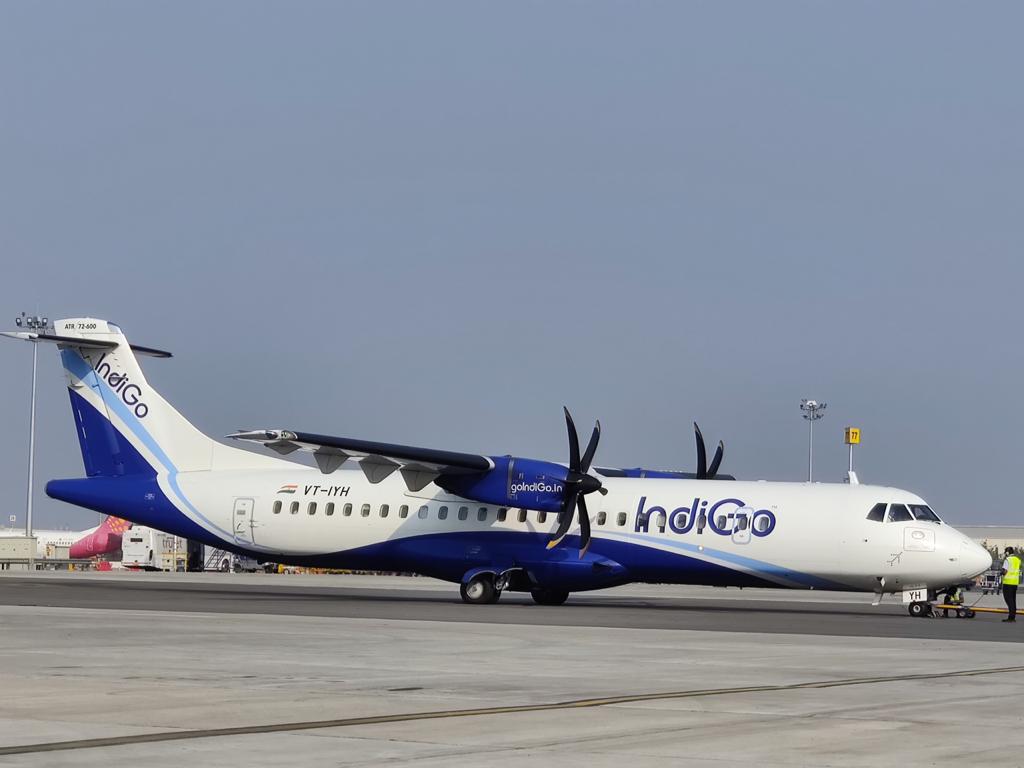
In what was a very big surprise, IndiGo placed an order for the ATR 72-600 in mid-2017 with the first deliveries starting November that year. Early this year, IndiGo took the delivery of the 50th aircraft from the original order and timed that delivery with the withdrawal from service of two ATRs with the effective operational fleet never reaching 50 planes. Of all its fleet, the deliveries for the ATRs were the slowest as it took seven and half years to induct 50 planes. For comparison, the airline took delivery of over 50 A320 family aircraft last year alone.
Data shared by Cirium, an aviation analytics company, exclusively for this post, shows that the airline is planning to operate 2134 flights a week on the ATR 72-600s. Overall the airline plans to operate 14,184 departures a week, which includes its entire fleet of dry as well as wet/damp leased planes. The ATRs thus make about 15% of all departures for the airline, but much fewer in terms of capacity (by ASK), which is just 2% of total capacity due to very short stage length and seats on offer. Capacity by ASK (Available Seat Kilometers) is calculated by multiplying the seats on offer and the kilometers planned for each flight.
Each air show has brought renewed focus on deals to be signed between ATR and IndiGo but thus far there have been none. These could be the five things holding back the order, as I had written in February this year.
The ATR deployment
Hyderabad, Bengaluru and Chennai see the highest departures for IndiGo ATRs with 259 weekly departures from Hyderabad, 196 weekly departures from Bengaluru and Chennai being neck to neck at 194 weekly departures.
The Chennai – Madurai – Chennai sector sees the maximum frequency amongst the ATR network with 56 weekly flights, which is eight times a day each way. This followed by 42 weekly flights (6 times a day) shared by Chennai – Trichy and Hyderabad – Rajahmundry.
Interestingly, 69 airports (including one international, Jaffna from Chennai and Trichy) see IndiGo’s ATR operations. The erstwhile longer routes like Vijayawada – Shirdi have since been terminated and the current longest route in its ATR network is Bhubaneshwar – Prayagraj at 711 kms while the shortest route is between Bengaluru and Salem at 178 kms.
While the airline managed to have some departures from Delhi, it continues to remain out of bounds from Mumbai. Maybe Navi Mumbai Airport could change that and the airline would relocate some ATRs there for more connectivity in the western region. While the Airbus flights are clocking in 13 hours utilisation and over 7 flights a day, the ATR network is more modest with a little over 6.5 flights a day on an average.
Top 10 airports by departures of ATR 72-600 of IndiGo
| Airport / City | Departures/ week |
| Hyderabad | 259 |
| Bengaluru | 196 |
| Chenai | 194 |
| Vijayawada | 90 |
| Kolkata | 85 |
| Ahmedabad | 84 |
| Madurai | 84 |
| Indore | 70 |
| Trichy | 70 |
| Jaipur | 69 |
Network Thoughts
Going by the numbers in public domain and cost calculations (largely back of the envelope level) shows that IndiGo’s cost of operation for ATR would not be in proportion to the capacity share. However, the cost would still be a small percentage and even when disproportionate it does not have a large impact on its finances. It has a higher proportion of route changes on its ATR routes than its Airbus routes. It can be looked at in two opposite ways. It either means that the airline has a low cost option of trying out flights and withdrawing when not working and also adding flights under the RCS-UDAN scheme at various airports, which could come as part of government initiative and requests to start operations.
This is by far the biggest turboprop network for any carrier in India. In the past both Jet Airways and Kingfisher Airlines have deployed the ATR aircraft and Alliance Air operates the ATR fleet. SpiceJet has the Q400s in its fleet, which are slowly getting ungrounded but the size remains smaller. The IndiGo fleet right now looks like a mix of shuttle markets like those to Madurai and a mix of smaller stations being joined as part of larger hub and spoke strategy, especially in the south.
The opening of NIA, Jewar and Navi Mumbai airport could possibly help the airline re-jig its network significantly to an extent that it can better route connecting traffic via these new airports and have a good hub and spoke network to support the initial days with focus on Mumbai and Delhi airports being largely Origin – Destination traffic.
Found this article informative? Think of supporting Network Thoughts with Power of 10

Running this website incurs some cost, along with the data sourced for analytics. If you have liked this article, consider paying INR 10 via UPI. The site will continue to be free. This will help with the maintenance, upkeep and funding the research. You can also pay via Debit or Credit card by clicking on this link.
You can support Network Thoughts by ordering Network Thoughts baggage tags !
Follow NetworkThoughts on X (Formerly Twitter), Bsky, Facebook and YouTube.